In part 1, a gentle introduction to positional encoding in transformer models, we discussed the positional encoding layer of the transformer model. We also showed how you could implement this layer and its functions yourself in Python. In this tutorial, you’ll implement the positional encoding layer in Keras and Tensorflow. You can then use this layer in a complete transformer model.
After completing this tutorial, you will know:
- Text vectorization in Keras
- Embedding layer in Keras
- How to subclass the embedding layer and write your own positional encoding layer.
Tutorial Overview
This tutorial is divided into three parts; they are:
- Text vectorization and embedding layer in Keras
- Writing your own positional encoding layer in Keras
- Randomly initialized and tunable embeddings
- Fixed weight embeddings from Attention Is All You Need
- Graphical view of the output of the positional encoding layer
First, let’s write the section to import all the required libraries:
| import tensorflow as tf from tensorflow import convert_to_tensor, string from tensorflow.keras.layers import TextVectorization, Embedding, Layer from tensorflow.data import Dataset import numpy as np import matplotlib.pyplot as plt |
Let’s start with a set of English phrases that are already preprocessed and cleaned. The text vectorization layer creates a dictionary of words and replaces each word with its corresponding index in the dictionary. Let’s see how you can map these two sentences using the text vectorization layer:
- I am a robot
- you too robot
Note the text has already been converted to lowercase with all the punctuation marks and noise in the text removed. Next, convert these two phrases to vectors of a fixed length 5. The TextVectorization layer of Keras requires a maximum vocabulary size and the required length of an output sequence for initialization. The output of the layer is a tensor of shape:
(number of sentences, output sequence length)
The following code snippet uses the adapt method to generate a vocabulary. It next creates a vectorized representation of the text.
| output_sequence_length = 5 vocab_size = 10 sentences = [["I am a robot"], ["you too robot"]] sentence_data = Dataset.from_tensor_slices(sentences) # Create the TextVectorization layer vectorize_layer = TextVectorization( output_sequence_length=output_sequence_length, max_tokens=vocab_size) # Train the layer to create a dictionary vectorize_layer.adapt(sentence_data) # Convert all sentences to tensors word_tensors = convert_to_tensor(sentences, dtype=tf.string) # Use the word tensors to get vectorized phrases vectorized_words = vectorize_layer(word_tensors) print("Vocabulary: ", vectorize_layer.get_vocabulary()) print("Vectorized words: ", vectorized_words) |
| Vocabulary: ['', '[UNK]', 'robot', 'you', 'too', 'i', 'am', 'a'] Vectorized words: tf.Tensor( [[5 6 7 2 0] [3 4 2 0 0]], shape=(2, 5), dtype=int64) |
The Embedding Layer
The Keras Embedding layer converts integers to dense vectors. This layer maps these integers to random numbers, which are later tuned during the training phase. However, you also have the option to set the mapping to some predefined weight values (shown later). To initialize this layer, you need to specify the maximum value of an integer to map, along with the length of the output sequence.
The Word Embeddings
Let’s see how the layer converts the vectorized_text to tensors.
| output_length = 6 word_embedding_layer = Embedding(vocab_size, output_length) embedded_words = word_embedding_layer(vectorized_words) print(embedded_words) |
The output has been annotated with some comments, as shown below. Note that you will see a different output every time you run this code because the weights have been initialized randomly.
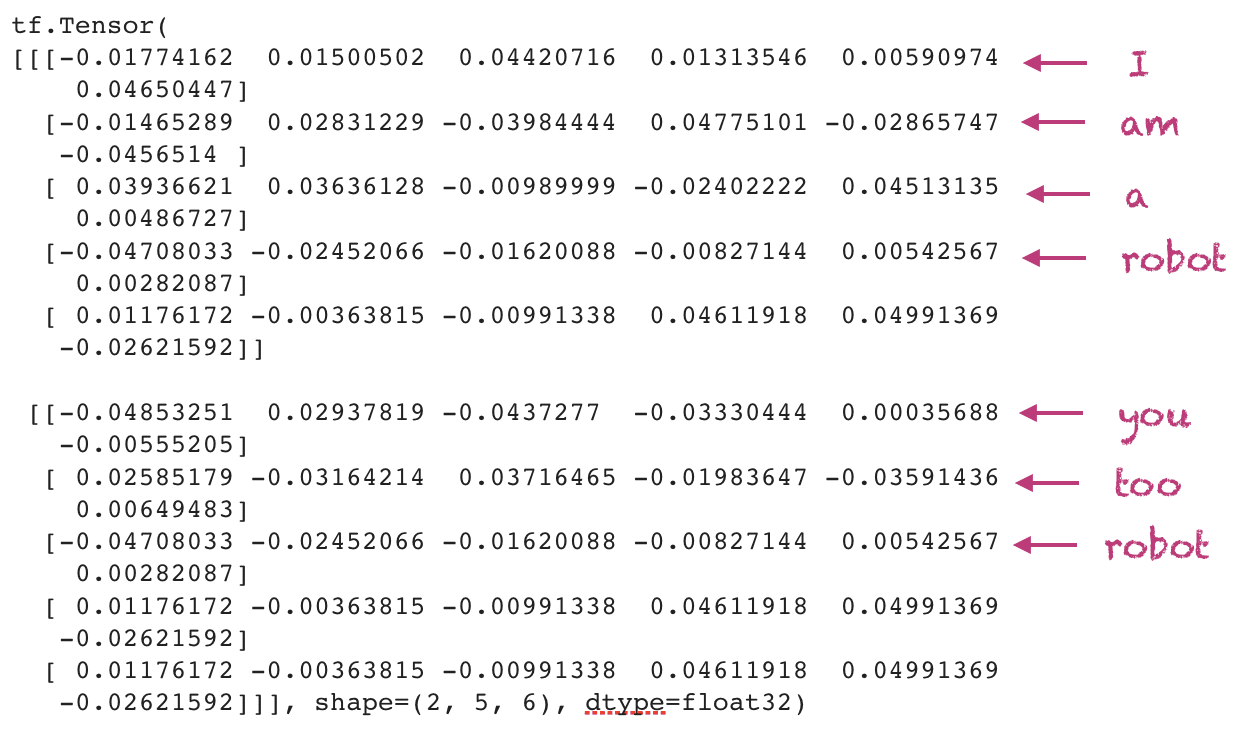
Word embeddings. This output will be different every time you run the code because of the random numbers involved.
You also need the embeddings for the corresponding positions. The maximum positions correspond to the output sequence length of the TextVectorization layer.
| position_embedding_layer = Embedding(output_sequence_length, output_length) position_indices = tf.range(output_sequence_length) embedded_indices = position_embedding_layer(position_indices) print(embedded_indices) |
The output is shown below:

Position indices embedding
In a transformer model, the final output is the sum of both the word embeddings and the position embeddings. Hence, when you set up both embedding layers, you need to make sure that the output_length is the same for both.
| final_output_embedding = embedded_words + embedded_indices print("Final output: ", final_output_embedding) |
The output is shown below, annotated with comments. Again, this will be different from your run of the code because of the random weight initialization.

The final output after adding word embedding and position embedding
When implementing a transformer model, you’ll have to write your own position encoding layer. This is quite simple, as the basic functionality is already provided for you. This Keras example shows how you can subclass the Embedding layer to implement your own functionality. You can add more methods to it as you require.
| class PositionEmbeddingLayer(Layer): def __init__(self, sequence_length, vocab_size, output_dim, **kwargs): super(PositionEmbeddingLayer, self).__init__(**kwargs) self.word_embedding_layer = Embedding( input_dim=vocab_size, output_dim=output_dim ) self.position_embedding_layer = Embedding( input_dim=sequence_length, output_dim=output_dim ) def call(self, inputs): position_indices = tf.range(tf.shape(inputs)[-1]) embedded_words = self.word_embedding_layer(inputs) embedded_indices = self.position_embedding_layer(position_indices) return embedded_words + embedded_indices |
Let’s run this layer.
| my_embedding_layer = PositionEmbeddingLayer(output_sequence_length, vocab_size, output_length) embedded_layer_output = my_embedding_layer(vectorized_words) print("Output from my_embedded_layer: ", embedded_layer_output) |
1 2 3 4 5 6 7 8 9 10 11 12 13 14 15 16 17 18 19 20 21 22 | Output from my_embedded_layer: tf.Tensor( [[[ 0.06798736 -0.02821309 0.00571618 0.00314623 -0.03060734 0.01111387] [-0.06097465 0.03966043 -0.05164248 0.06578685 0.03638128 -0.03397174] [ 0.06715029 -0.02453769 0.02205854 0.01110986 0.02345785 0.05879898] [-0.04625867 0.07500569 -0.05690887 -0.07615659 0.01962536 0.00035865] [ 0.01423577 -0.03938593 -0.08625181 0.04841495 0.06951572 0.08811047]] [[ 0.0163899 0.06895607 -0.01131684 0.01810524 -0.05857501 0.01811318] [ 0.01915303 -0.0163289 -0.04133433 0.06810946 0.03736673 0.04218033] [ 0.00795418 -0.00143972 -0.01627307 -0.00300788 -0.02759011 0.09251165] [ 0.0028762 0.04526488 -0.05222676 -0.02007698 0.07879823 0.00541583] [ 0.01423577 -0.03938593 -0.08625181 0.04841495 0.06951572 0.08811047]]], shape=(2, 5, 6), dtype=float32) |
Positional Encoding in Transformers: Attention Is All You Need
Note the above class creates an embedding layer that has trainable weights. Hence, the weights are initialized randomly and tuned in to the training phase.
The authors of
Attention Is All You Need have specified a positional encoding scheme, as shown below. You can read the full details in
part 1 of this tutorial:
If you want to use the same positional encoding scheme, you can specify your own embedding matrix, as discussed in
part 1, which shows how to create your own embeddings in NumPy. When specifying the
Embedding layer, you need to provide the positional encoding matrix as weights along with
trainable=False. Let’s create another positional embedding class that does exactly this.
1 2 3 4 5 6 7 8 9 10 11 12 13 14 15 16 17 18 19 20 21 22 23 24 25 26 27 28 29 30 31 | class PositionEmbeddingFixedWeights(Layer): def __init__(self, sequence_length, vocab_size, output_dim, **kwargs): super(PositionEmbeddingFixedWeights, self).__init__(**kwargs) word_embedding_matrix = self.get_position_encoding(vocab_size, output_dim) position_embedding_matrix = self.get_position_encoding(sequence_length, output_dim) self.word_embedding_layer = Embedding( input_dim=vocab_size, output_dim=output_dim, weights=[word_embedding_matrix], trainable=False ) self.position_embedding_layer = Embedding( input_dim=sequence_length, output_dim=output_dim, weights=[position_embedding_matrix], trainable=False ) def get_position_encoding(self, seq_len, d, n=10000): P = np.zeros((seq_len, d)) for k in range(seq_len): for i in np.arange(int(d/2)): denominator = np.power(n, 2*i/d) P[k, 2*i] = np.sin(k/denominator) P[k, 2*i+1] = np.cos(k/denominator) return P def call(self, inputs): position_indices = tf.range(tf.shape(inputs)[-1]) embedded_words = self.word_embedding_layer(inputs) embedded_indices = self.position_embedding_layer(position_indices) return embedded_words + embedded_indices |
Next, we set up everything to run this layer.
| attnisallyouneed_embedding = PositionEmbeddingFixedWeights(output_sequence_length, vocab_size, output_length) attnisallyouneed_output = attnisallyouneed_embedding(vectorized_words) print("Output from my_embedded_layer: ", attnisallyouneed_output) |
1 2 3 4 5 6 7 8 9 10 11 12 13 14 15 16 17 18 19 20 21 22 | Output from my_embedded_layer: tf.Tensor( [[[-0.9589243 1.2836622 0.23000172 1.9731903 0.01077196 1.9999421 ] [ 0.56205547 1.5004725 0.3213085 1.9603932 0.01508068 1.9999142 ] [ 1.566284 0.3377554 0.41192317 1.9433732 0.01938933 1.999877 ] [ 1.0504174 -1.4061394 0.2314966 1.9860148 0.01077211 1.9999698 ] [-0.7568025 0.3463564 0.18459873 1.982814 0.00861763 1.9999628 ]] [[ 0.14112 0.0100075 0.1387981 1.9903207 0.00646326 1.9999791 ] [ 0.08466846 -0.11334133 0.23099795 1.9817369 0.01077207 1.9999605 ] [ 1.8185948 -0.8322937 0.185397 1.9913884 0.00861771 1.9999814 ] [ 0.14112 0.0100075 0.1387981 1.9903207 0.00646326 1.9999791 ] [-0.7568025 0.3463564 0.18459873 1.982814 0.00861763 1.9999628 ]]], shape=(2, 5, 6), dtype=float32) |
In order to visualize the embeddings, let’s take two bigger sentences: one technical and the other one just a quote. We’ll set up the TextVectorization layer along with the positional encoding layer and see what the final output looks like.
1 2 3 4 5 6 7 8 9 10 11 12 13 14 15 16 17 18 19 20 21 22 23 24 25 26 27 28 | technical_phrase = "to understand machine learning algorithms you need" +\ " to understand concepts such as gradient of a function "+\ "Hessians of a matrix and optimization etc" wise_phrase = "patrick henry said give me liberty or give me death "+\ "when he addressed the second virginia convention in march" total_vocabulary = 200 sequence_length = 20 final_output_len = 50 phrase_vectorization_layer = TextVectorization( output_sequence_length=sequence_length, max_tokens=total_vocabulary) # Learn the dictionary phrase_vectorization_layer.adapt([technical_phrase, wise_phrase]) # Convert all sentences to tensors phrase_tensors = convert_to_tensor([technical_phrase, wise_phrase], dtype=tf.string) # Use the word tensors to get vectorized phrases vectorized_phrases = phrase_vectorization_layer(phrase_tensors) random_weights_embedding_layer = PositionEmbeddingLayer(sequence_length, total_vocabulary, final_output_len) fixed_weights_embedding_layer = PositionEmbeddingFixedWeights(sequence_length, total_vocabulary, final_output_len) random_embedding = random_weights_embedding_layer(vectorized_phrases) fixed_embedding = fixed_weights_embedding_layer(vectorized_phrases) |
Now let’s see what the random embeddings look like for both phrases.
| fig = plt.figure(figsize=(15, 5)) title = ["Tech Phrase", "Wise Phrase"] for i in range(2): ax = plt.subplot(1, 2, 1+i) matrix = tf.reshape(random_embedding[i, :, :], (sequence_length, final_output_len)) cax = ax.matshow(matrix) plt.gcf().colorbar(cax) plt.title(title[i], y=1.2) fig.suptitle("Random Embedding") plt.show() |
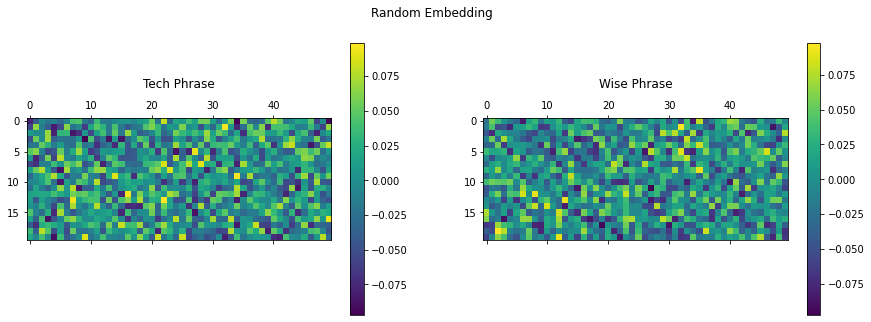
Random embeddings
The embedding from the fixed weights layer are visualized below.
| fig = plt.figure(figsize=(15, 5)) title = ["Tech Phrase", "Wise Phrase"] for i in range(2): ax = plt.subplot(1, 2, 1+i) matrix = tf.reshape(fixed_embedding[i, :, :], (sequence_length, final_output_len)) cax = ax.matshow(matrix) plt.gcf().colorbar(cax) plt.title(title[i], y=1.2) fig.suptitle("Fixed Weight Embedding from Attention is All You Need") plt.show() |
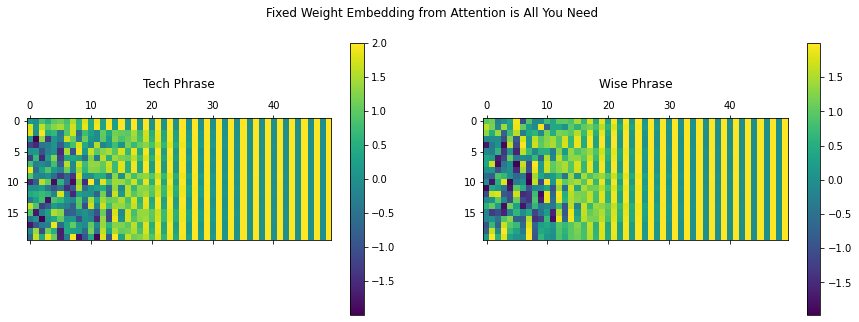
Embedding using sinusoidal positional encoding
You can see that the embedding layer initialized using the default parameter outputs random values. On the other hand, the fixed weights generated using sinusoids create a unique signature for every phrase with information on each word position encoded within it.
You can experiment with tunable or fixed-weight implementations for your particular application.
This section provides more resources on the topic if you are looking to go deeper.
Books
Papers
Articles
Summary
In this tutorial, you discovered the implementation of positional encoding layer in Keras.
Specifically, you learned:
- Text vectorization layer in Keras
- Positional encoding layer in Keras
- Creating your own class for positional encoding
- Setting your own weights for the positional encoding layer in Keras
Do you have any questions about positional encoding discussed in this post? Ask your questions in the comments below, and I will do my best to answer.






No comments:
Post a Comment