There’s a paradox in the world of AI: While it’s the largest economic opportunity of our lifetime (estimated to contribute $16 trillion to GDP by 2030), enterprise adoption of AI was less than 4% in 2018. A recent Gartner survey said that the 4% in 2018 has now grown to 14% in 2019. But still, that is meager. This is for a variety of reasons: lack of skills, lack of tools, lack of confidence, etc. But the biggest issue is cultural.
For organizations that want to participate in this phase of innovation and wealth creation in technology, the most important thing is a beginner’s mindset; a willingness to try, and an acceptance of failure. Organizations should seek to do 100 AI experiments a year, knowing that more than 50% will fail. Many company cultures are not suited for that. A more typical approach is to rally around one big AI project, committing a lot of people, time and money. I do not advise that approach. AI is about mass experimentation, not one big project implementation. This ain’t ERP.
Fortune favors the bold. I believe that the trial and error all have gone through – and will continue to go through – is worth the positive outcomes. Not just because of the economic opportunity, but the potential to help businesses, consumers, and ultimately, the world in which we live. There will be more experimentation, more failures, more successes. And certainly, many changes to how we live and work. It is up to all of us to ensure that those changes are for the better.
I believe every human being on Earth will interact with Watson in some way – whether it’s accelerating the customer service they receive, augmenting the work they do, improving their retail experiences, providing medical insights to their caregivers, helping them to avoid food scarcity, or even ways that have not been conceived yet. Our ambition has not relaxed. IBM will continue to pioneer AI for all.
 Why
do I believe this? Because a crucial element for AI to succeed is
trust. Companies must be confident that, despite issues of trial and
error, they can ultimately trust AI to make meaningful connections and
recommendations based on data. So, when it comes to AI, trust will be
hugely important in determining which companies succeed and which ones
will not. You can say many things about IBM, but I don’t believe anyone
thinks IBM is not to be trusted. Our track record as an institution
speaks for itself.
Why
do I believe this? Because a crucial element for AI to succeed is
trust. Companies must be confident that, despite issues of trial and
error, they can ultimately trust AI to make meaningful connections and
recommendations based on data. So, when it comes to AI, trust will be
hugely important in determining which companies succeed and which ones
will not. You can say many things about IBM, but I don’t believe anyone
thinks IBM is not to be trusted. Our track record as an institution
speaks for itself.
Consider our AI client product references. We have more public references in AI than any other company. And, note my choice of words: these are not custom services engagements as references. I’m talking about clients who are using the products that I describe in the first two posts, like Watson OpenScale, Assistant and AutoAI, to name a few. Now, in some instances, do clients hire IBM services (or the services of other systems integrators) to help? Absolutely. But Watson has moved well beyond custom services.
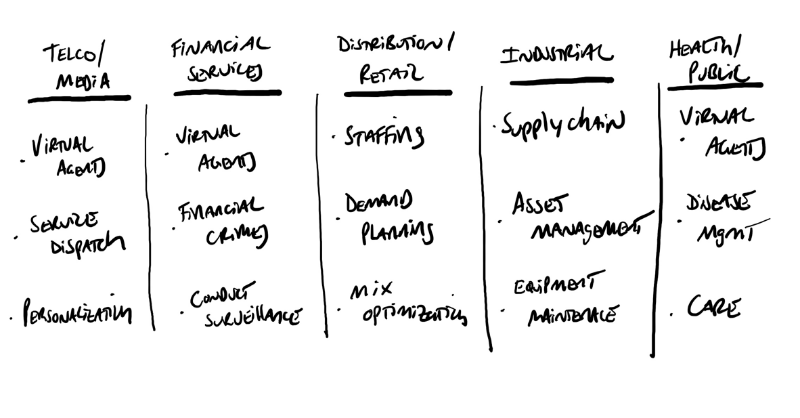
And as more of our clients tell their AI stories, they inspire others to consider, engage and experiment. I’m excited by the scope of adoption, especially across a variety of industries. So far, the most common use cases I see, by industry, are as follows:
The Main Event
This week we will celebrate our clients’ successes in driving Watson across throughout their enterprises, across hybrid multicloud environments. We call it ‘Watson Anywhere.’ It’s an approach that brings AI to wherever the data resides – across any cloud – to help companies unearth hidden insights, automate processes and ultimately drive business performance. We’ll highlight innovative work by companies like KPMG, Air France-KLM and Humana, who have adopted the Watson Anywhere strategy to knock down data silos to bring AI to their data.
Watson Anywhere is more than just a great way of doing AI. It’s based on real innovation, at the core of which is our Cloud Pak for Data – a microservices based data and analytics platform that’s built on Red Hat OpenShift. On this platform, organizations can take Watson tools and apps to literally any cloud they wish – wherever their data resides – be it on IBM Cloud, AWS, Azure, Google, or their own private cloud.
IBM will continue to have a positive impact on the world with Watson, increasing adoption and enabling users and companies to participate in the $16 trillion of wealth creation. We also know that we will do it in the way that you expect from IBM: thoughtful, trusted, and measured. With AI in the right hands, we will all win. Why not give it a try?






No comments:
Post a Comment