This tutorial is an extension of Method Of Lagrange Multipliers: The Theory Behind Support Vector Machines (Part 1: The Separable Case)) and explains the non-separable case. In real life problems positive and negative training examples may not be completely separable by a linear decision boundary. This tutorial explains how a soft margin can be built that tolerates a certain amount of errors.
In this tutorial, we’ll cover the basics of a linear SVM. We won’t go into details of non-linear SVMs derived using the kernel trick. The content is enough to understand the basic mathematical model behind an SVM classifier.
After completing this tutorial, you will know:
- Concept of a soft margin
- How to maximize the margin while allowing mistakes in classification
- How to formulate the optimization problem and compute the Lagrange dual
Let’s get started.

Method Of Lagrange Multipliers: The Theory Behind Support Vector Machines (Part 2: The Non-Separable Case).
Photo by Shakeel Ahmad, some rights reserved.
Tutorial Overview
This tutorial is divided into 2 parts; they are:
- The solution of the SVM problem for the case where positive and negative examples are not linearly separable
- The separating hyperplane and the corresponding relaxed constraints
- The quadratic optimization problem for finding the soft margin
- A worked example
Pre-requisites
For this tutorial, it is assumed that you are already familiar with the following topics. You can click on the individual links to get more information.
- A Gentle Introduction to Optimization / Mathematical Programming
- A Gentle Introduction To Method Of Lagrange Multipliers
- Lagrange Multiplier Approach with Inequality Constraints
- Method Of Lagrange Multipliers: The Theory Behind Support Vector Machines (Part 1: The Separable Case))
Notations Used In This Tutorial
This is a continuation of Part 1, so the same notations will be used.
: Total training points : Data point, which is an -dimensional vector. Each dimension is indexed by j. : Positive example : Negative example : Subscript used to index the training points. : Subscript to index a dimension of the data point. : Label of data points. It is an m-dimensional vector : Transpose operator : Weight vector denoting the coefficients of the hyperplane. It is an -dimensional vector : Vector of Lagrange multipliers, an -dimensional vector : Vector of Lagrange multipliers, again an -dimensional vector : Error in classification. An -dimensional vector
Want to Get Started With Calculus for Machine Learning?
Take my free 7-day email crash course now (with sample code).
Click to sign-up and also get a free PDF Ebook version of the course.
The Separating Hyperplane and Relaxing the Constraints
Let’s find a separating hyperplane between the positive and negative examples. Just to recall, the separating hyperplane is given by the following expression, with
As we allow positive and negative examples to lie on the wrong side of the hyperplane, we have a set of relaxed constraints. Defining
Also for negative examples we require:
Combining the above two constraints by using the class label
The variable
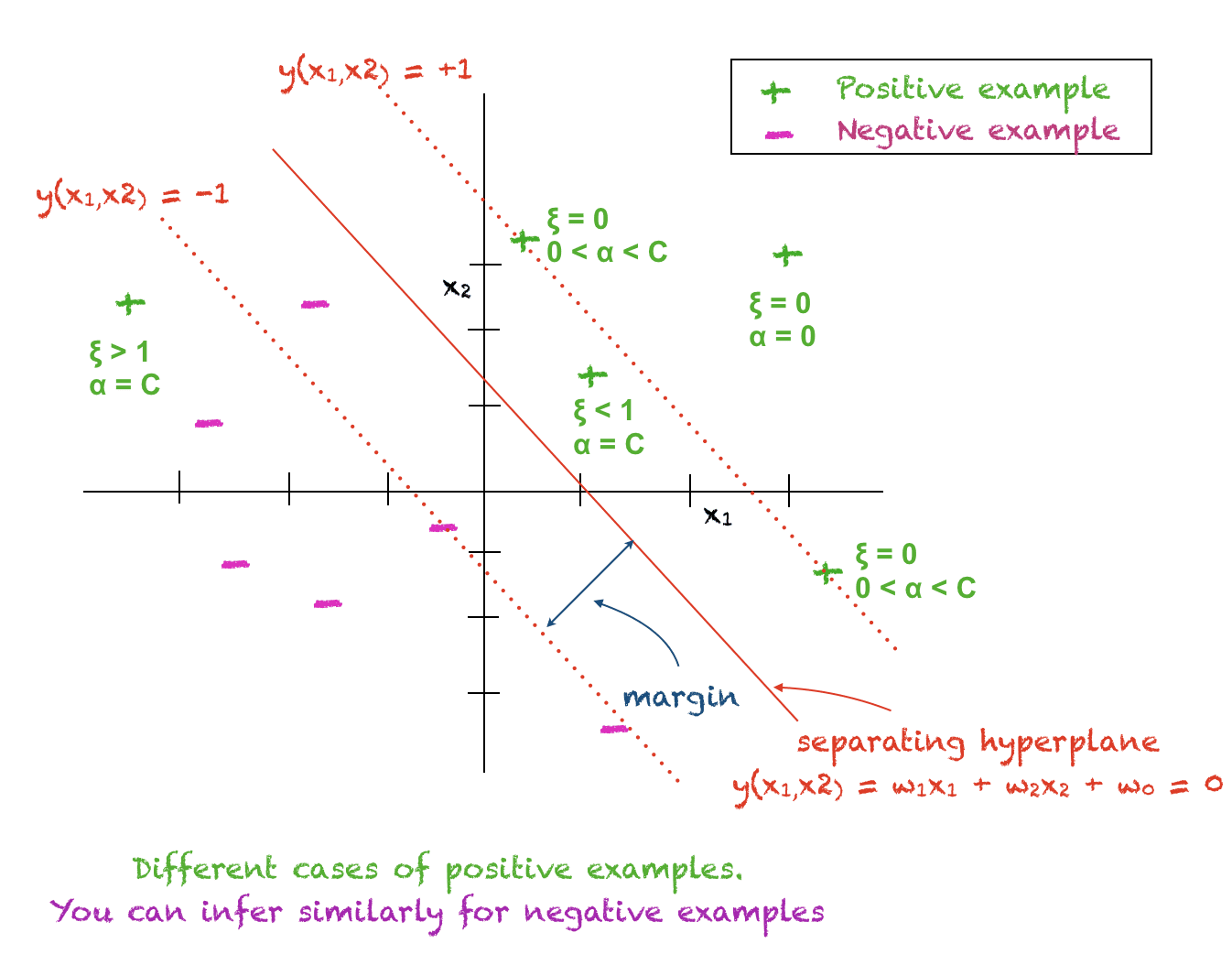
: This means that is correctly classified and this data point is on the correct side of the hyperplane and away from the margin. : When this condition is met, lies on the correct side of the hyperplane but inside the margin. : Satisfying this condition implies that is misclassified.
Hence,
The Quadratic Programming Problem
We are now in a position to formulate the objective function along with the constraints on it. We still want to maximize the margin, i.e., we want to minimize the norm of the weight vector. Along with this, we also want to keep the soft error as small as possible. Hence, now our new objective function is given by the following expression, with
The overall quadratic programming problem is, therefore, given by the following expression:
The Role of C, the Regularization Constant
To understand the penalty factor
In short, a large value of
Solution Via The Method Of Lagrange Multipliers
Let’s use the method of Lagrange multipliers to solve the quadratic programming problem that we formulated earlier. The Lagrange function is given by:
To solve the above, we set the following:
Solving the above gives us:
and
Substitute the above in the Lagrange function gives us the following optimization problem, also called the dual:
We have to maximize the above subject to the following constraints:
Similar to the separable case, we have an expression for
Interpretation of the Mathematical Model and Computation of
Following cases are true for each training data point
: The ith training point lies on the correct side of the hyperplane away from the margin. This point plays no role in the classification of a test point. : The ith training point is a support vector and lies on the margin. For this point and and hence it can be used to compute . In practice is computed from all support vectors and an average is taken. : The ith training point is either inside the margin on the correct side of the hyperplane or this point is on the wrong side of the hyperplane.
The picture below will help you understand the above concepts:
Deciding The Classification of a Test Point
The classification of any test point
A positive value of
Karush-Kuhn-Tucker Conditions
Karush-Kuhn-Tucker (KKT) conditions are satisfied by the above constrained optimization problem as given by:
A Solved Example
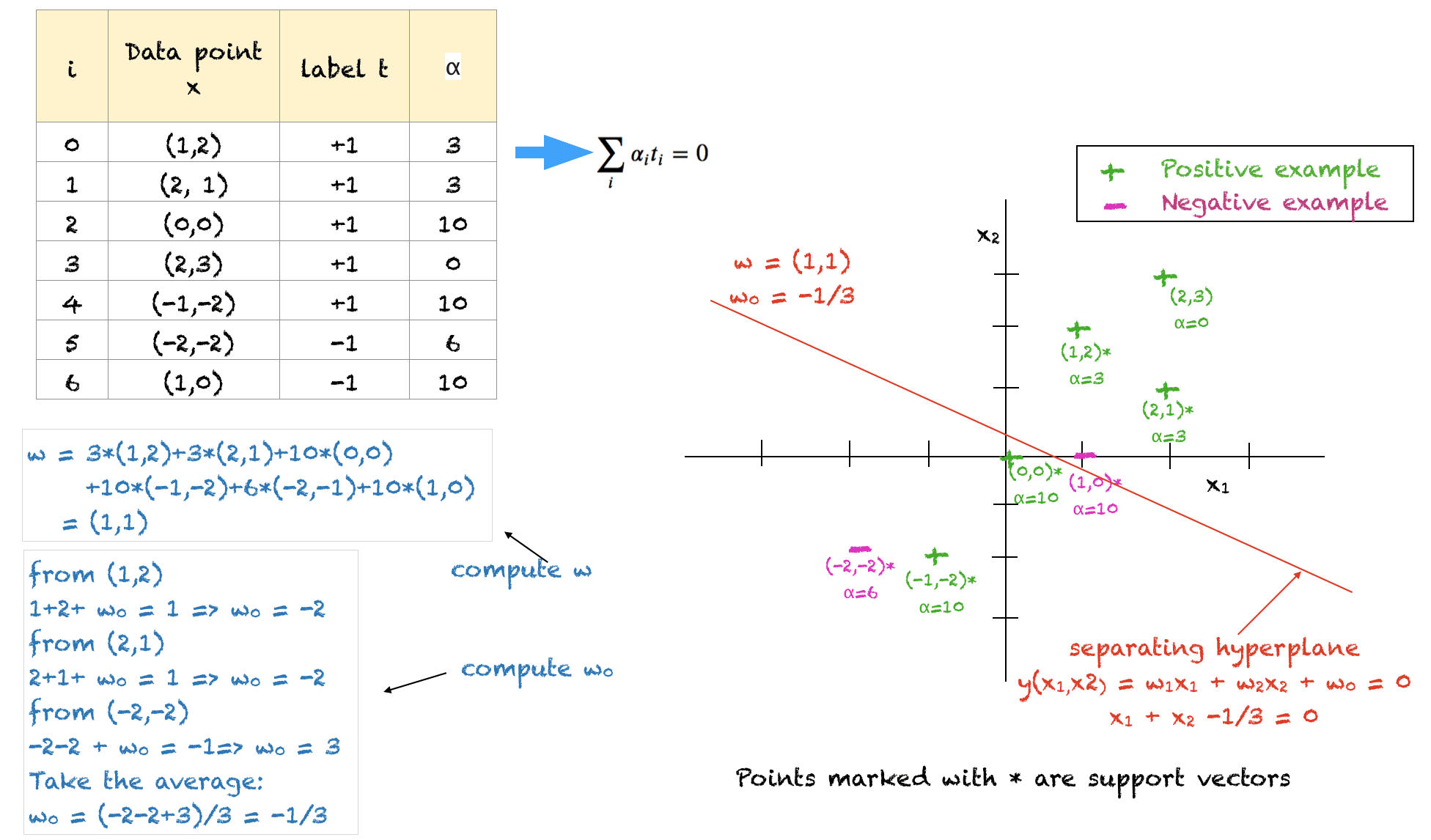
Shown above is a solved example for 2D training points to illustrate all the concepts. A few things to note about this solution are:
- The training data points and their corresponding labels act as input
- The user defined constant
is set to 10 - The solution satisfies all the constraints, however, it is not the optimal solution
- We have to make sure that all the
lie between 0 and C - The sum of alphas of all negative examples should equal the sum of alphas of all positive examples
- The points (1,2), (2,1) and (-2,-2) lie on the soft margin on the correct side of the hyperplane. Their values have been arbitrarily set to 3, 3 and 6 respectively to balance the problem and satisfy the constraints.
- The points with
lie either inside the margin or on the wrong side of the hyperplane
Further Reading
This section provides more resources on the topic if you are looking to go deeper.
Books
- Pattern Recognition and Machine Learning by Christopher M. Bishop
Articles
- Support Vector Machines for Machine Learning
- A Tutorial on Support Vector Machines for Pattern Recognition by Christopher J.C. Burges
Summary
In this tutorial, you discovered the method of Lagrange multipliers for finding the soft margin in an SVM classifier.
Specifically, you learned:
- How to formulate the optimization problem for the non-separable case
- How to find the hyperplane and the soft margin using the method of Lagrange multipliers
- How to find the equation of the separating hyperplane for very simple problems
Do you have any questions about SVMs discussed in this post? Ask your questions in the comments below and I will do my best to answer.






No comments:
Post a Comment